
What Happens in a Lomi Lomi Session Is Not What You Think
Prefer to listen? Press play for the audio version of this article.
The difference between technique and attunement, and why the most transformative bodywork operates through relationship rather than method

Opening
You have almost certainly had a good massage before. Skilled hands, the right pressure, a therapist who knew where to work. You left feeling looser. Maybe you booked another one for six weeks later because your shoulders had gone back to holding what they always hold.
Now think about the handful of times in your life when touch did something different. A hand on your back during a hard conversation that actually settled you, rather than one that felt like a formality. A hug from someone who was fully there, distinct from the version where you can feel the other person is already thinking about their next task. You know the difference. Everyone does. What almost nobody has is language for why it happens, or evidence that the difference is real and not a matter of mood.
It is real. It is measurable. And it is the entire distinction between a massage and a Lomi Lomi session.
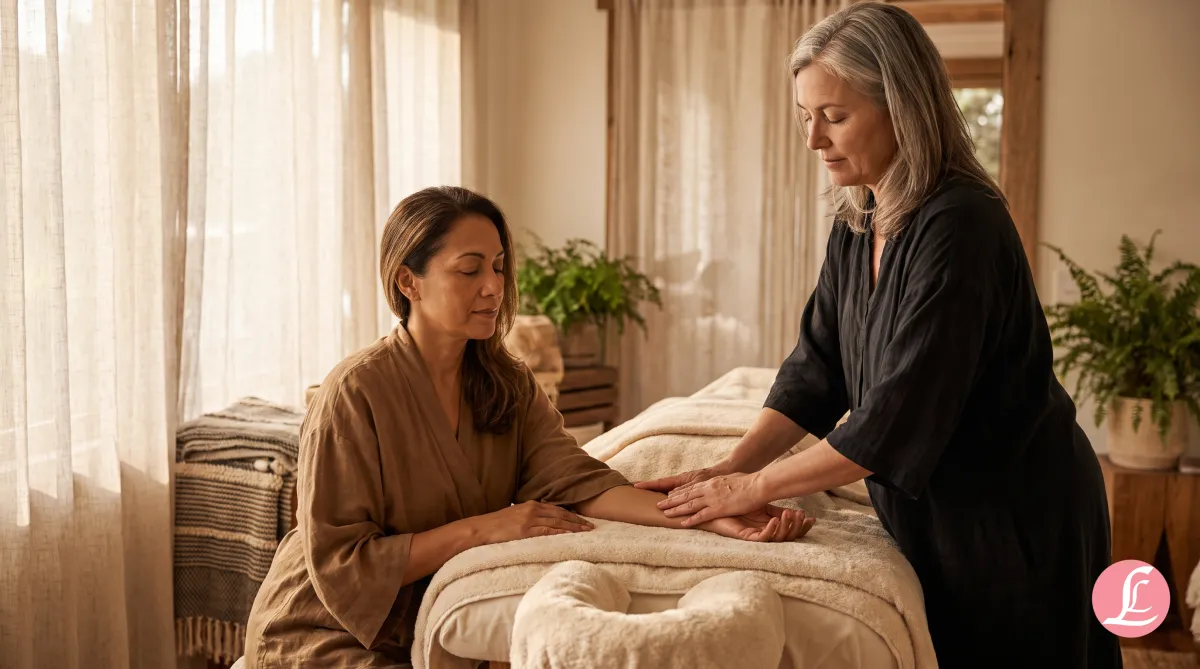
Most people arrive at their first Lomi Lomi session expecting a more elaborate technique. Longer strokes, forearms instead of hands, a name that sounds like ceremony rather than service. What they are not expecting, and what the research below explains, is that the technique is not the active ingredient. The relationship is.

Evidence Foundation
Three separate fields of research point to the same conclusion: touch delivered inside a genuinely attuned relationship produces different physiological outcomes than technically identical touch delivered without it.
The first is the neuroscience of the skin itself. Human hairy skin contains a distinct class of nerve fibre, C tactile afferents, that fire preferentially in response to slow, gentle stroking at a very specific speed, roughly one to ten centimetres per second, and skin temperature contact (Löken et al., 2022). These afferents are not general purpose touch sensors. Discriminative touch, the kind that tells you where you have been touched and with what, travels through an entirely separate pathway (McGlone, Wessberg, & Olausson, 2014). C tactile afferents exist specifically to register social, affective touch, and their activation projects to brain regions associated with reward and emotional meaning rather than the somatosensory map alone (Morrison, Löken, & Olausson, 2010). This is the physiological basis of why the same pressure, applied with attentive slowness rather than mechanical efficiency, registers as an entirely different experience in your nervous system.
The second line of evidence comes from oxytocin research. Skin to skin contact reliably raises oxytocin levels and this release is associated with reduced activity in the stress response system, lowered cortisol, and a shift toward parasympathetic dominance (Uvnäs Moberg, Handlin, & Petersson, 2020). Crucially, this effect is context dependent. Oxytocin release through touch is influenced by the social and relational quality of the contact, not by the mechanical properties of the stimulus alone (Uvnäs Moberg & Petersson, 2022). The same forearm stroke, delivered by a stranger rushing through a service transaction versus a practitioner who is genuinely present, is not the same input to your endocrine system.
The third line of evidence is the largest and the most surprising to the Orange minded reader who assumes technique determines outcome. Across more than five decades of psychotherapy outcome research, the quality of the relationship between practitioner and client, referred to in the literature as the therapeutic alliance, accounts for a substantially larger share of positive outcome than the specific technique or method used (Flückiger, Del Re, Wampold, & Horvath, 2018). This finding has been replicated across modalities that are procedurally very different from each other, which means the active ingredient is not any single method. It is the presence of a genuine, attuned relationship, a concept given full theoretical grounding in Daniel Siegel's interpersonal neurobiology, where attunement is described as one mind's resonance with another's internal state, generating measurable shifts in nervous system regulation for both people (Siegel, 1999). And this relational effect is not limited to talking therapies. Interpersonal physiological synchrony, the alignment of heart rhythms between two people, has been shown to track directly with how connected and cohesive people report feeling in each other's company (Tomashin, Gordon, & Wallot, 2022).
Skin science, endocrinology, and relational research all arrive at the same place from three different directions. Technique creates the conditions for something to happen. Attunement is what actually happens.

Depth Layer
Here is where this matters for you directly, and where the case for the cost of pure individualism becomes concrete rather than philosophical.
If you have approached self care the way you approach most things in your life, which is to say, competently, you have likely selected practitioners the way you select any other service provider. Credentials. Reviews. A sense that the technique on offer is sound. This is a reasonable strategy for choosing a mechanic. It is an incomplete strategy for choosing someone whose hands will be on your body, because the research above says the credentials and the technique are necessary and not sufficient. What determines whether your nervous system actually settles is something the intake form cannot capture: whether the person providing the touch is genuinely, attentively present with you, or is performing competence at you.
This is a distinction that Hawaiian Lomi Lomi tradition has held as central for centuries, long before Western neuroscience developed the instruments to measure it. Kumu Dane Silva, a traditional Hawaiian practitioner, describes traditional Lomi Lomi as a relationship, not a transaction, extended toward the recipient and toward the wider web of connection the Hawaiian tradition calls ohana (MASSAGE Magazine, 2024). This is offered here as cultural and practitioner testimony, not as a peer reviewed empirical claim, and it is presented with full respect as its own legitimate way of knowing, standing alongside rather than beneath the research above. Traditional Lomi Lomi practitioners set an intention before a session begins, a deliberate act of arriving fully before the hands ever touch skin. Contemporary neuroscience gives us a mechanism for why that pause matters: it is the practitioner regulating their own nervous system before attempting to offer regulation to someone else's, which prior research (Porges, 2011) identifies as the precondition for any co regulatory exchange between two people to succeed at all.
This reframes what you are actually paying for when you book a Lomi Lomi session. Not sixty minutes of technique. Sixty minutes inside a relational field, held by a practitioner whose own regulated presence is the primary active ingredient. The forearms, the flowing strokes, the rhythm, all of it matters, and none of it works the same way without the attunement underneath it.
You are allowed to want this. Wanting a genuinely attuned encounter is not a lesser or more indulgent request than wanting a technically proficient one. It is, according to the evidence, the more precise request. Article 8 goes further into what moderate pressure specifically does to the brain, and Article 17 addresses the far less discussed skill of actually letting yourself receive this kind of attention once it is offered.

The Living Practice: Conscious Touch Self Practice
You do not need a practitioner present to begin building your own capacity to notice this distinction. This is a solo sequence, roughly ten minutes, best done seated or lying down somewhere quiet.
Begin with your hands. Place one hand on your forearm and, rather than gripping or rubbing quickly, move it slowly along your skin, at a pace closer to five centimetres per second than you would naturally choose. Notice what changes when you slow down further than feels efficient.
Move to your chest, one hand resting flat, and simply notice the rise and fall of your breath under your palm for six full breaths. Do not try to change the breath. Just register it.
Bring both hands to the sides of your neck, gently, and hold for thirty seconds. Notice whether your shoulders soften without instruction.
Throughout, track these nervous system cues rather than any particular sensation in the tissue itself. Whether your breath rate slows. Whether your jaw unclenches. Whether the quality of your attention shifts from monitoring your surroundings to being genuinely inside your own body. These are the markers of C tactile activation and early parasympathetic engagement described in the Evidence Foundation above, now generated through your own attention rather than another person's hands.
This practice builds the same capacity Lomi Lomi asks of you in a session: to actually be present for touch, rather than tolerating it while your mind is elsewhere. Practise it daily for a week and notice whether it becomes easier to arrive.

Closing Invitation
You have spent a long time being extremely good at choosing well. Good practitioners, good providers, good technique. That discernment has served you. What this article is asking you to add to it, not replace it with, is a second filter: does this person actually arrive when they are with you.
You now have the evidence for what you were probably already sensing in your body every time a session felt different for reasons you could not name.
If you would like to experience what a fully attuned Lomi Lomi session feels like when technique and presence are both genuinely in the room, the Introductory Offer is the most direct way to begin. Begin with the Introductory Offer
References
Feldman, R., Magori Cohen, R., Galili, G., Singer, M., & Louzoun, Y. (2011). Mother and infant coordinate heart rhythms through episodes of interaction synchrony. Infant Behavior and Development, 34(4), 569 to 577.
Flückiger, C., Del Re, A. C., Wampold, B. E., & Horvath, A. O. (2018). The alliance in adult psychotherapy: A meta analytic synthesis. Psychotherapy, 55(4), 316 to 340.
Löken, L. S., Backlund Wasling, H., Olausson, H., McGlone, F., & Wessberg, J. (2022). A topographical and physiological exploration of C tactile afferents and their response to menthol and histamine. Journal of Neurophysiology, 127(2), 463 to 473.
MASSAGE Magazine. (2024, June 12). Lomi Lomi: Traditional vs. contemporary.
McGlone, F., Wessberg, J., & Olausson, H. (2014). Discriminative and affective touch: Sensing and feeling. Neuron, 82(4), 737 to 755.
Morrison, I., Löken, L. S., & Olausson, H. (2010). The skin as a social organ. Experimental Brain Research, 204(3), 305 to 314.
Porges, S. W. (2011). The polyvagal theory: Neurophysiological foundations of emotions, attachment, communication, and self regulation. W. W. Norton.
Pukui, M. K., & Elbert, S. H. (1986). Hawaiian dictionary: Hawaiian English, English Hawaiian (Rev. ed.). University of Hawaii Press.
Siegel, D. J. (1999). The developing mind: Toward a neurobiology of interpersonal experience. Guilford Press.
Tomashin, A., Gordon, I., & Wallot, S. (2022). Interpersonal physiological synchrony predicts group cohesion. Frontiers in Human Neuroscience, 16, Article 903407.
Uvnäs Moberg, K., Handlin, L., & Petersson, M. (2020). Neuroendocrine mechanisms involved in the physiological effects caused by skin to skin contact. Infant Behavior and Development, 61, Article 101482.
Uvnäs Moberg, K., & Petersson, M. (2022). Physiological effects induced by stimulation of cutaneous sensory nerves, with a focus on oxytocin. Current Opinion in Behavioral Sciences, 43, 159 to 166.
Share This Article
If this gave language to something you have been experiencing, you may wish to share it with someone who would recognise it too.