Lomi Lomi Gold Coast
You Already Know Something Is Possible Here
Your nervous system has been asking for a different kind of input. Not more information. Not another framework to understand yourself through. An actual experience of what becomes possible when every dimension of the pattern is addressed at once.
This is the InfiniteYou approach. Ninety days. Seven modalities. A system of care designed for women who have already done significant work and are ready for the layer beneath the layer.
You do not need to be convinced that this is relevant. You are already reading carefully. That is enough.
RECEIVE THE GUIDE
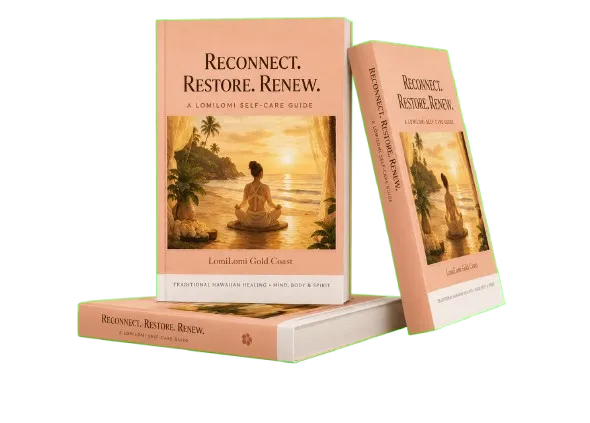
Reconnect, Restore, Renew
A gentle guide to help you come home to yourself and begin your healing journey.
SAFE. GROUNDED SPACE
Safe. Supportive. Compassionate.
NERVES & BODY
Soothe. restore. Reconnect.

ROOTED IN ALOHA
Ancient wisdom. Modern care.
Three Entry Points.
One Coherent Journey.
This is not a product menu. This is a pathway that opens after your complimentary Clarity Session. Each offer is a natural next step from the one before it. You may enter at any point, though the sequence is designed so that each experience deepens the next.
Deepen Individually
Introductory Offer
Three sessions introducing the practice and the method. Direct experience of integrated somatic care.
A bespoke prescription for your specific nervous system and an honest conversation about what is possible next.
Begin Here
Aloha Circle
A seven-hour immersive gathering for ten women.
Embodied experience of the community frequency. Collective nervous system intelligence. The practice of shared intention.
Your Destination
InfiniteYou
Programme
Ninety days. Seven modalities.
The full architecture.
Cellular, somatic, and wholeness. The full sequence of Release, Reconnect, and Renew.
What Twenty-Five Thousand Sessions Teaches You About the Nervous System
Stone Gye has delivered more than 25,000 sessions across Lomi Lomi, hypnotherapy, NLP, counselling, and coaching since 2008. Trained by Tracey Laka i na pali in traditional Hawaiian Lomi Lomi. Experienced practitioner at Gwinganna Health Resort.
His own neurodivergent profile has expanded his capacity to work across the full range of lived experiences with precision and care.
He uses attunement and observational tracking to create connections. The result is a quality of presence that clients consistently describe as unlike anything they have encountered before.
He meets people where they are.
Not where they perform.
Not a Collection of Sessions. A System of Care.
Every modality in the InfiniteYou Programme exists in precise relationship with every other. HBOT oxygenates the cellular environment where deep cellular restoration occurs. Lomi Lomi releases what the body has been holding in tissue and autonomic state. Hypnotherapy reaches the unconscious programming that conscious intention cannot shift alone.
Counselling gives language to what emerges. Coaching translates transformation into direction. Reflexology and contrast therapy soothe the nervous system between deeper sessions.
Remove any one of these and the system is less.
Together, they address the pattern at every level it operates.
If the Pattern Has Become Clearer in Recent Years
Many women arrive here after a long period of precision and management. The strategies that created their capable life are beginning to cost more than they return.
Perimenopause often makes visible what was previously compensated for. The energy that sustained certain modes of operating is redirected. What was hidden becomes available. This is not a decline. It is information.
The InfiniteYou approach is designed for the woman who is intelligent enough to recognise this shift as an opening rather than a loss and who is ready to meet what is on the other side of it with full presence.
Current Insights
QUESTIONS YOU MAY BE HOLDING
Frequently Asked Questions (FAQs)
You do not need to have everything figured out before you begin. These are some of the questions women commonly carry when considering care, connection and a different relationship with their nervous system.
Why do I feel isolated even though my life looks full?
This is one of the most common and least spoken questions among accomplished women, and it deserves a direct answer rather than a reassurance. Research comparing loneliness across genders has found that despite maintaining larger social networks than men, women report equal or greater loneliness (Maes, Qualter, Vanhalst, Van den Noortgate, and Goossens, 2019). The explanation is not a personal shortcoming. It is structural. Genuine connection requires emotional intimacy and authentic vulnerability, and most social contexts, including the ones that look successful from the outside, are built around performance rather than depth.
You have likely spent years becoming excellent at appearing regulated, capable, and available, because that performance has served you professionally and socially. But performance and connection draw on different nervous system states. A social calendar full of appropriate interactions can coexist with a nervous system that has not felt truly met in a long time.
This is not a flaw to correct. It is an accurate signal that you are ready for a different kind of space, one where authenticity is structurally required rather than optional. Community models built around explicit agreements, such as confidentiality, consent, and welcoming all responses without judgement, create the conditions where performance is no longer necessary (Yalom and Leszcz, 2005). Belonging of this kind is not only an emotional experience. It correlates with measurable improvements in vagal tone, inflammation, and immune function (Cacioppo and Patrick, 2008). The isolation you feel is real, and it is also expandable. It is the accurate signal pointing you toward the room where the mask is not required.
Is it self-indulgent to prioritise my own nervous system?
This question tends to arrive dressed as a moral one, but it is actually a physiological one. An achievement-oriented woman who has built something of substance often equates her own regulation with a luxury she has not yet earned, or a task to schedule after everyone else's needs are met. The research points in the other direction.
Vagal tone, the activation level of the ventral vagal branch of the parasympathetic nervous system, is directly trainable, and higher vagal tone correlates with better emotional regulation, stronger immune function, reduced inflammation, and greater capacity for genuine social engagement (Porges, 2011). In practice, this means your capacity to be fully present for the people who rely on you, the very thing you may be delaying your own care in service of, depends on the state of your own nervous system first. Co-regulation between people is real and measurable using heart rate variability, and a more regulated nervous system in a room measurably supports the regulation of others nearby (Stellar, Cohen, Oveis, and Keltner, 2015).
Chronic sympathetic activation, the state many high-functioning women live in without naming it, is also linked to increased inflammatory markers over time (Danese and McEwen, 2012). Attending to your own regulation is therefore not a withdrawal from your responsibilities. It is closer to the foundation those responsibilities are actually built on. The question is not whether you deserve this. The question is what becomes available to the people around you once your own system has somewhere to land.
Why does receiving care feel harder than giving it?
Many women who are exceptionally attuned to the needs of others find that lying still and letting someone else attend to them is one of the more difficult things they do. This is not a personal quirk. It reflects a nervous system that has been organised, often for very good reasons, around vigilance and giving rather than receiving.
Oxytocin, the neurohormone underlying bonding and felt safety, is released through safe, attuned touch, but the research is specific about frequency. Studies on repeated exposure to bonding stimuli show that oxytocin receptor density builds over time with consistency, rather than through single isolated events (Takahashi et al., 2025). A single session can create a temporary shift. A sustained, trusted relationship with a practitioner or a community allows the nervous system to build the deeper capacity for receiving that a one-off experience cannot.
There is also a defensive pattern worth naming without judgement. Bracing, hypervigilance, and a felt need to stay useful or in control are recognised responses to sustained stress, and they are addressed through the same channel they were formed in: the body, not the intellect (Ogden, Minton, and Pain, 2006). A structured, consent-based practice of learning to receive, paced at your own tempo, is not indulgent or regressive. It is the direct rebuilding of a capacity that circumstance may have asked you to set aside for a long time. This capacity expands with practice, and it expands further inside a relationship of trust rather than in a single transactional visit.
What is actually happening in my body during a Lomi Lomi session, beyond relaxation?
This question deserves the evidence, not just the description. Lomi Lomi is frequently categorised as massage, and while the description is technically accurate, it understates what is occurring physiologically. According to Polyvagal Theory, the autonomic nervous system moves through a hierarchy of states: ventral vagal social engagement, sympathetic mobilisation, and dorsal vagal shutdown (Porges, 2011). Safe, rhythmic, attuned touch is one of the most direct pathways available for supporting movement back toward the ventral vagal state, where genuine rest, connection, and repair become physiologically possible.
Multiple mechanisms operate simultaneously during a session. Moderate pressure touch specifically, not light touch, has been shown to produce measurable reductions in cortisol alongside increases in serotonin and dopamine (Field, Hernandez-Reif, Diego, Schanberg, and Kuhn, 2005; Field, Diego, and Hernandez-Reif, 2010). Oxytocin release supports both the immediate sense of safety and, with repetition, longer-term shifts in how the nervous system interprets touch and closeness (Uvnäs-Moberg, Handlin, and Petersson, 2015). Research on repeated massage-like stimulation also points to longer-term effects on how the nervous system processes pain and stress, likely mediated in part through oxytocinergic pathways (Lund et al., 2002).
None of this replaces psychological work, and it is not presented here as a singular cure. It works alongside it, addressing a layer that cognitive approaches alone are not designed to reach, because these patterns are held in the body's implicit, pre-verbal systems rather than in conscious narrative (van der Kolk, 2014). What is happening in a session is closer to nervous system recalibration than to a spa treatment, and the research base behind it is substantial and growing.
Why do I crave depth in my relationships now, when surface connection used to be enough?
This shift is a recognisable developmental one rather than a sign that something has gone wrong. As individualist, achievement-oriented ways of operating mature, a felt need for relational depth and communal intelligence tends to emerge alongside them, not in place of them (Beck and Cowan, 1996). What once felt like sufficient connection, transactional, pleasant, low risk, can begin to feel thin against a need for authenticity you may not yet have language for.
Genuine presence with another person is a distinct neurological and relational state from simply being available. It draws on the same regulated, ventral vagal capacity involved in co-regulation, meaning the quality of your presence in a relationship is directly tied to the quality of your own nervous system state in that moment (Porges, 2011). This is not a purely psychological preference. Oxytocin synchrony between people in genuine connection has measurable correlates, and heart rate variability studies show that nervous systems entrain toward each other's regulation when the relationship is safe enough to allow it (Stellar, Cohen, Oveis, and Keltner, 2015).
The Aloha concept of pono, or rightness in relationship, names this precisely. It describes an encounter met from full presence rather than performed engagement (Beck and Cowan, 1996; Porges, 2011). Your craving for depth is not a complaint about the people around you. It is the accurate signal of a nervous system and a developmental stage becoming capable of more than it could hold before.
How do I know when solo self-care is not enough, and I need something structured, like Aloha Circle or InfiniteYou?
The signal is usually a plateau rather than a crisis. Individual practices, journaling, exercise, occasional bodywork, produce real benefit, but research on therapeutic community models consistently finds that structured, sustained, multi-modal engagement produces outcomes that brief or solitary interventions do not reach (Kennard, 2004). The reason is not that solo practice lacks value. It is that certain forms of healing, particularly nervous system patterns built over years, require co-regulation, mutual witnessing, and consistency that a self-directed routine cannot supply on its own.
There is also a specific therapeutic factor at work in group settings that individual practice cannot replicate: universality, the direct experience of discovering that your particular struggle is shared rather than uniquely yours (Yalom and Leszcz, 2005). This is measurable, not just anecdotal. Group settings using heart rate variability monitoring show that more regulated nervous systems in a room support the regulation of less settled ones nearby (Stellar, Cohen, Oveis, and Keltner, 2015), producing collective capacity that no individual in the room holds alone.
A reasonable marker that you are ready for a more structured container is this: you have done meaningful individual work, you can name your patterns clearly, and you still find yourself repeating them in ways insight alone has not shifted. That gap between understanding and lived change is precisely where sustained community and multi-modal practice, of the kind Aloha Circle and InfiniteYou are built around, tend to do the work that solo practice cannot finish alone.
What does perimenopause have to do with realising I might be neurodivergent?
This is a genuinely under-discussed intersection, and it deserves a clear, evidence-grounded answer rather than a vague reassurance. Women reaching perimenopause are more likely to receive a neurodivergent diagnosis at that life stage than at any other (Craddock, 2024). This is not because neurodivergence appears suddenly in midlife. Oestrogen plays a meaningful role in dopamine availability and emotional regulation, and as oestrogen levels shift during perimenopause, coping strategies that have operated automatically for decades, often described in the literature as masking, can become far harder to sustain (Autistic Girls Network, 2025; Bristol Menopause, 2025).
Masking itself carries a documented cost. It has been described in the research as the sustained, often unconscious mimicking of neurotypical behaviour at significant emotional and energetic expense (Bristol Menopause, 2025). Qualitative research with autistic women describes this hormonal period using language as direct as the felt experience of a long held structure breaking open (Moseley, Turner-Cobb, Spence, and Attwood, 2020).
The reframe worth holding is this: this is not a breakdown, and it is not evidence that something is newly wrong with you. It is more accurately described as an unmasking, an opening into a version of yourself that adaptive performance has been quietly protecting for a long time. For women who have not yet reached this stage, this understanding still has value now, as an invitation to build a relationship with your own nervous system ahead of a transition the body will eventually ask for regardless.
Why does grief still live in my body years after the loss, and what do I do with it?
Grief that persists somatically long after a loss is not a sign of unresolved weakness or a failure to move on. It reflects an accurate feature of how grief actually works in the body. Complicated or prolonged grief responses are a recognised area of clinical research in their own right, distinct from ordinary bereavement, and they are understood to have physiological as well as emotional dimensions (Shear, 2015). Mindfulness based approaches to bereavement care specifically attend to the body's role in holding grief that words and cognitive processing alone do not fully metabolise (Cacciatore and Flint, 2012).
Western frameworks tend to treat grief as an emotion to be processed and concluded, with an implicit expectation of an endpoint. Somatic approaches work from a different premise: that grief is not the absence of love but love without a place to go, and that the body needs a way to complete cycles of holding and release that cognitive processing alone cannot finish. Trauma and loss research broadly supports the idea that unprocessed experience is held in implicit, body based memory systems rather than purely narrative ones (van der Kolk, 2014).
What this means practically is that grief work through touch, breath, and community is not a replacement for time or for professional grief support, particularly where grief has become complicated or is affecting daily functioning. It is a complementary pathway that reaches a layer that talking alone does not always reach, and it gives grief a container, and companions, rather than requiring you to metabolise it in isolation.
What does it mean to heal collectively rather than alone, and why can't therapy alone give me that?
Individual therapy provides something genuinely essential: a skilled, dedicated relationship focused entirely on your process. But it has a structural limitation worth naming honestly. In that relationship, you are always the one being held, and the exchange is necessarily asymmetrical. Group and community based healing offers something different in kind, not just in degree.
Group therapeutic research identifies altruism, the direct experience of being helpful to someone else's healing, as one of the most significant therapeutic factors available, precisely because it cannot occur in a purely one directional relationship (Yalom and Leszcz, 2005). Alongside altruism, universality, discovering that your specific pain is recognisably shared, dissolves a particular kind of isolation that individual work, however excellent, cannot directly address, because it requires the presence of others who have lived something similar (Yalom and Leszcz, 2005).
This is not only a psychological effect. Genuine belonging, built on being seen without needing to perform, correlates with measurable improvements in vagal tone, inflammation, and immune function (Cacioppo and Patrick, 2008), and co-regulation between nervous systems in a group setting is observable using heart rate variability data (Stellar, Cohen, Oveis, and Keltner, 2015). Therapy and community are not competing options. They address different, complementary layers of the same healing process, and the reciprocity available only in community, where you are both held and holding, is not something a one to one relationship, however skilled, is structured to provide.
How does a regulated nervous system today shape the length and quality of my life decades from now?
This question moves the frame from immediate relief to legacy, and the research base supporting it is substantial. Populations studied in the Blue Zones research, communities with an unusually high proportion of people living well past ninety, share a consistent cluster of factors, and social connection and a settled relationship to stress sit among the most consistent of them, alongside movement, purpose, and diet (Buettner, 2008; Buettner and Skemp, 2016).
Loneliness and social isolation are independently associated with increased mortality risk, at a scale comparable to other well established health risks, across a substantial meta-analytic evidence base (Holt-Lunstad, Smith, Baker, Harris, and Stephenson, 2015). Chronic nervous system dysregulation, meanwhile, is linked over time to elevated inflammatory markers and the cluster of conditions associated with sustained physiological stress (Danese and McEwen, 2012). Put simply, the state your nervous system spends most of its time in is not only about how today feels. It is one of the more consistently evidenced predictors of how long, and how well, your life unfolds.
This does not mean any single practice guarantees a particular outcome, and no claim of that kind would be honest. What the evidence does support is a coherent direction: a nervous system that has regular access to safety, rhythm, community, and attuned touch is building toward a different long-term trajectory than one that does not. Longevity, in this frame, is not a separate goal from your daily practice. It is the accumulated shape of it.
The Conversation Costs Nothing
The Clarity Session is 45 minutes. Complimentary. It is not a sales call. It is a conversation about whether this practice and this moment in your life are aligned.
Some women book the programme. Some book the introductory sessions. Some come back in six months. All three are fine.
What is not fine is continuing to carry what no longer needs to be carried when who you are is waiting to continue to thrive.
Copyright 2026. Lomi Lomi Gold Coast. All Rights Reserved.