
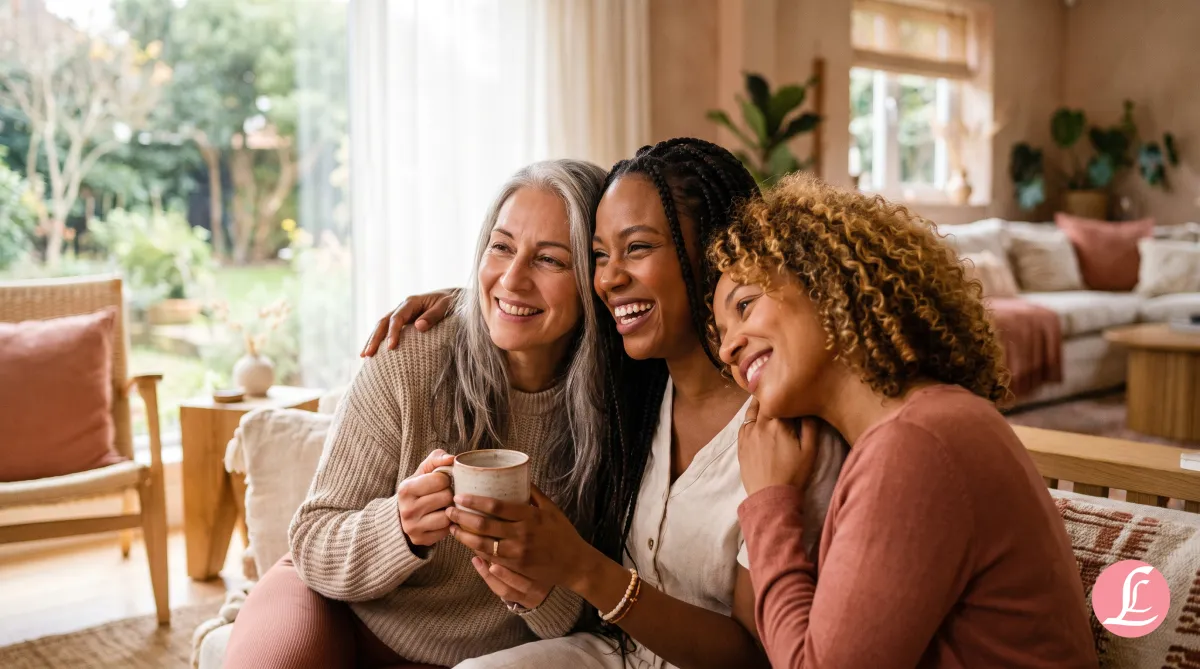
The Neuroscience of Why Women Heal Better Together
Prefer to listen? Press play for the audio version of this article.
Collective effervescence, oxytocin synchrony, and the specific neurological events that only occur in genuine community

Opening
You have likely done a great deal of healing work alone. Journaling alone. Reflecting alone. Working through difficult material in the privacy of your own mind, at your own pace, on your own schedule. This has served you, and it has also, quite possibly, taken you as far as solo work can take a person, which the evidence below suggests has a genuine ceiling.
You were never designed to do this work entirely by yourself. Not as a matter of personal preference or emotional inclination, but as a matter of measurable neurobiology. There are specific physiological and neurological events that occur only in the presence of genuine, attuned human community, events your solo practice, however excellent, simply cannot generate on its own. This article gives you the evidence for what happens in genuine circle, and why it produces outcomes that individual work alone does not replicate.

Evidence Foundation
Three separate disciplines, spanning sociology, evolutionary anthropology, and neuroscience, converge on the finding that collective, attuned gathering produces specific effects unavailable to the solitary individual.
The first is sociological, and considerably older than the neuroscience that has since validated it. The sociologist Émile Durkheim described a phenomenon he termed collective effervescence, the heightened, shared emotional intensity that arises specifically when a group gathers with shared focus and purpose, producing a felt sense of connection and meaning that exceeds what any individual member experiences alone (Durkheim, 1995). Durkheim was writing more than a century ago, without access to the physiological tools available today, and yet he identified something the neuroscience described below has since given a measurable biological basis.
The second is evolutionary. Robin Dunbar's social brain hypothesis proposes that the unusually large human neocortex evolved specifically to manage the cognitive demands of complex social groups, establishing that humans are, at a fundamental evolutionary level, built for group living rather than solitary function (Dunbar, 1998). This is not a sentimental claim about the nice to have benefits of friendship. It is an evolutionary argument that a significant portion of human cognitive architecture exists specifically because our ancestors needed to track, understand, and coordinate with other people, across generations, in order to survive and raise the next generation successfully together. A nervous system built by this evolutionary pressure is unlikely to reach its full regulatory capacity in isolation, no matter how skilled or self sufficient the individual carrying that nervous system happens to be.
The third is direct physiological evidence of what actually happens between people sharing a room. Interpersonal physiological synchrony, the alignment of heart rhythms between people, has been shown to directly and prospectively predict how connected and cohesive a group reports feeling, measured across genuine group settings rather than isolated pairs alone (Tomashin, Gordon, & Wallot, 2022). A related and more specific line of research examined physiological concordance between individual therapist and patient pairs, finding that skin conductance patterns became more closely aligned during moments of higher perceived empathy between the two people, and that this alignment correlated with more positive social and emotional exchange during the same session (Marci, Ham, Moran, & Orr, 2007). A further, influential though not entirely uncontested body of neuroscience proposes that mirror neurons, cells that fire both when a person acts and when they observe someone else perform a similar action, provide part of the biological substrate for empathy, allowing one person's witnessed experience to activate related neural patterns in an observing companion nearby (Iacoboni, 2009).
A fourth, related strand of evidence concerns the endocrine system specifically. Oxytocin release, already established elsewhere in this series as central to touch, connection, and reduced stress reactivity, is understood to occur not only between two people but across groups engaged in genuine, synchronised, positive social interaction, with the quality and context of that shared interaction shaping the degree of release rather than group presence alone guaranteeing it automatically (Uvnäs Moberg & Petersson, 2022). This adds a fourth, hormonal layer to the picture, alongside the sociological, evolutionary, and physiological synchrony evidence already described, and helps explain why a genuinely well held circle feels calming at a bodily level that a poorly held or superficial group gathering simply does not replicate.
Four disciplines, one convergent picture emerging clearly from very different starting points. A sociologist identified the phenomenon of heightened collective experience over a century ago, long before modern instruments existed to measure it directly (Durkheim, 1995). Evolutionary science explains precisely why the human brain is specifically built for this kind of sustained group experience rather than solitary function across an entire lifetime (Dunbar, 1998). Contemporary physiological and neuroscience research demonstrates measurable synchrony and shared neural activation occurring specifically between people in genuine connection, at both the wider group level and the smaller individual pair level (Tomashin et al., 2022; Marci et al., 2007; Iacoboni, 2009). And the endocrine research adds the hormonal mechanism underneath all of it (Uvnäs Moberg & Petersson, 2022). This is not mysticism dressed up in scientific language. This is a genuinely convergent, cross disciplinary account of why certain forms of healing appear to specifically require other people to be authentically present in the room with you.

Depth Layer
Here is what this evidence means for you directly, and it deserves to be said with full respect for the considerable capability you have already brought to your own healing journey up to this point.
If you have done extensive solo work, insight, reflection, self directed practice of real depth and consistency, and still find yourself circling the same territory without the full shift you were genuinely hoping for, this is not evidence that you have done something wrong or that your effort has been insufficient in any way. According to the evidence above, certain neurological and physiological events required for the deepest kind of shift simply do not occur in isolation, regardless of how skilled the individual attempting them happens to be. You have very likely been doing genuinely excellent work with only part of the required ingredients available to you at any given time.
This is where the cost of pure individualism becomes most concrete and most personally relevant. Individualism has likely taught you, across your entire life, that genuine strength means handling your own healing privately and independently, and that needing witnessed, co regulated experience with other people is somehow a lesser or more dependent way of doing this important work. The evidence above says something quite different. Needing genuine community for certain kinds of healing is not a deficiency in your independence or your considerable capability. It is an accurate reflection of a nervous system built, across an enormous span of evolutionary time, specifically for this kind of sustained connection with others (Dunbar, 1998).
There is something genuinely edifying available in this reframe, once you allow yourself to actually receive it. The women who thrive most fully are not the ones who have somehow managed to need other people the very least. They are, more precisely, the women who have understood, accurately and without shame, that certain forms of regulation and healing were never meant to be generated entirely alone, and who have therefore built genuine community around themselves quite deliberately, with the same clear headed intentionality they already bring to every other important area of their considerable and capable lives.
Article 3 established the physiological basis of Aloha and genuine presence earlier in this series, and this article builds directly upon that same foundation at a wider group level. Article 17 continues this thread in a closely related direction, addressing the specific and often overlooked skill of genuinely receiving what a community, or indeed a single person, offers you, rather than quietly managing the experience from a safe emotional distance even while you remain physically present in the room.

The Living Practice: The Community Nervous System Map
This is a structured exercise, taking around twenty minutes with a notebook, designed to identify precisely where genuine co regulation currently occurs in your life, and equally where it is genuinely absent, so that you can design intentional community engagement going forward rather than leaving something this important entirely to chance.
Begin by listing every relationship and regular gathering currently active in your life. Family, friendships, professional relationships, and any group or community you currently belong to, formally or informally. For each one, rate honestly, on a scale of one to ten, the degree of genuine co regulation you personally experience there, meaning the degree to which you feel authentically witnessed and settled in that particular connection, rather than simply present, polite, or quietly performing social competence for the benefit of others.
Separate this full list into two clear columns. Relationships and spaces that genuinely co regulate you on a consistent basis, and relationships and spaces that are present in your life without meaningfully providing this for you. Notice the honest ratio between these two columns, without judgement toward yourself or toward anyone named on either side of the list.
Once you have completed both columns, look specifically for patterns rather than isolated entries. Notice whether your genuinely co regulating connections cluster around a particular kind of setting, a particular size of gathering, or a particular quality of person, since this pattern is itself useful data for deciding where to invest your limited time and energy going forward. Notice too whether any relationships you assumed were genuinely nourishing actually score lower than expected once you apply this honest scale, and sit with that finding rather than dismissing it.
Now identify, specifically and concretely, what is genuinely missing. If your genuinely co regulating column is short, or entirely empty right now, this is not a personal failing deserving of any shame whatsoever. It is an accurate, evidence based diagnosis of a specific and entirely addressable gap, precisely the kind of gap the research above suggests deserves deliberate, considered attention rather than being left to arrive by pure chance over time. Use this completed map to make one specific, concrete decision about where you will intentionally build or meaningfully deepen a genuinely co regulating connection over the coming month.

Closing Invitation
You have likely been doing remarkable, genuinely admirable work entirely on your own for a very long time. This article is not suggesting that any of that work was wasted or misdirected. It is suggesting, with real evidence behind it, that there is a further layer available to you that solo work, by its very nature and design, simply cannot reach on its own, no matter how long you continue it.
If you would like to experience this kind of genuine, co regulating community directly and for yourself, the Introductory Offer is the most direct and accessible way to begin exploring this work in a fully supported setting. Begin with the Introductory Offer
References
Dunbar, R. I. M. (1998). The social brain hypothesis. Evolutionary Anthropology, 6(5), 178 to 190.
Durkheim, É. (1995). The elementary forms of religious life (K. E. Fields, Trans.). Free Press. (Original work published 1912)
Iacoboni, M. (2009). Imitation, empathy, and mirror neurons. Annual Review of Psychology, 60, 653 to 670.
Marci, C. D., Ham, J., Moran, E., & Orr, S. P. (2007). Physiologic correlates of perceived therapist empathy and social emotional process during psychotherapy. Journal of Nervous and Mental Disease, 195(2), 103 to 111.
Tomashin, A., Gordon, I., & Wallot, S. (2022). Interpersonal physiological synchrony predicts group cohesion. Frontiers in Human Neuroscience, 16, Article 903407.
Uvnäs Moberg, K., & Petersson, M. (2022). Physiological effects induced by stimulation of cutaneous sensory nerves, with a focus on oxytocin. Current Opinion in Behavioral Sciences, 43, 159 to 166.
Share This Article
If this gave language to something you have been experiencing, you may wish to share it with someone who would recognise it too.